
Sixty bottles
On fountain pens, the acquisition trap, and the difference between loving a thing and collecting it.

There’s a particular kind of collector who buys sneakers they never wear. Who fills a room with craft supplies and calls it a creative practice. Who owns more books than they could read in a lifetime and keeps buying more anyway. The acquisition becomes the point - the research, the hunt, the arrival of the package - and the original reason quietly steps aside.
One day you realise you’re one of them.
I have loved handwriting for as long as I can remember. This is a strange thing to say because I was terrible at it as a child. Bad enough that I’d convinced myself, with the particular anxiety of a small kid who makes mountains out of molehills, that I was going to have to repeat first grade. At some point around the age of ten I decided I was going to fix that. I did. I spent days writing and rewriting, practising letters, changing how I formed things until it looked the way I wanted it to. I am not someone who normally sticks at things I’m not immediately good at. With this I did, and I don’t entirely know why.
That relationship never went away. I still write most of my notes by hand - not because you retain information better that way, which is the reason people usually give, but as an excuse to use my pens. When I’m bored in a meeting I don’t doodle. I write words and letters, trying out different ways of forming them. It’s part of why I have penpals. Another excuse to use stationery and ink and the pens I love.
The irony is that I get terrible writer’s cramp. My own favourite thing causes me pain. I write anyway.
I came to fountain pens the way I suspect most people do. They felt special. Grown-up. A small, quiet signal that you took your own handwriting seriously. Not to be A Writer. Just to write with something that felt like it deserved the effort. I had two pens. That was enough.
Then someone who absolutely should not have spent that much money on a gift gave me a Graf von Faber-Castell. I used it for a few years, anxiously, barely taking it out of the house – I was worried that I would break or lose a very.valuable.thing. Eventually I was talked into selling it. The logic was that a pen I was too nervous to carry wasn’t earning its place. That was probably a mistake. 1
After that I bought a few more pens over time. Not many. At some point I’d decided that pens were beautiful tools for me, not objects to own. I have a penpal with over 120 fountain pens, including vintage Montblancs, and I get it completely. Fountain pens are genuinely beautiful things and some people collect them with the same knowledge and seriousness that others bring to art or watches or rare books. That’s a legitimate thing. It’s just not mine. What sparks joy is holding and using them.
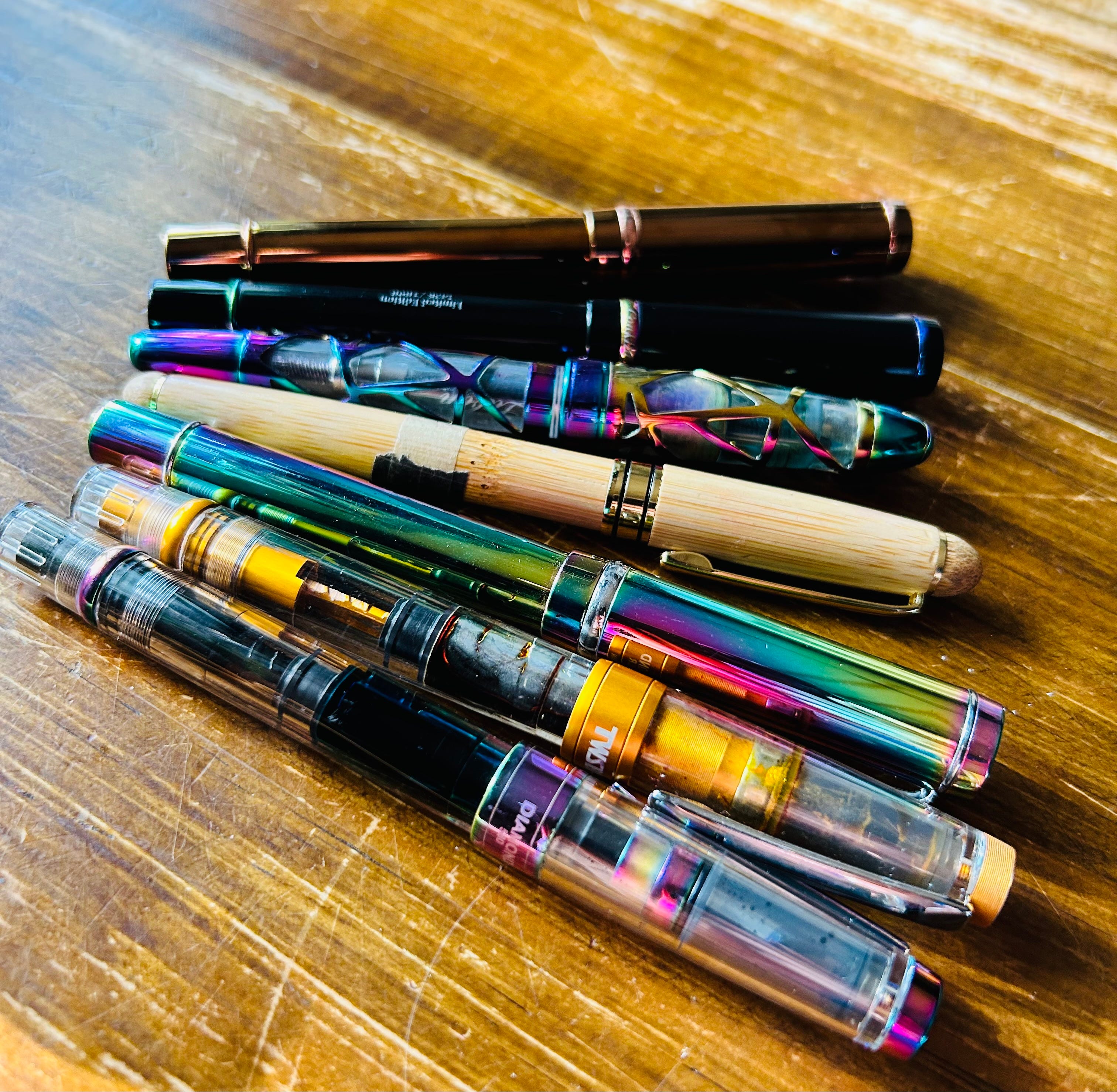
What I have now is a small collection I genuinely use - a couple of TWBSIs, a few Conklins, one of which is slightly broken in a way the company won’t fix because it was a limited run, and which I use anyway. Several of them have that iridescent rainbow finish, the full oil-slick effect. I won’t pretend that’s not a factor. One is a clear demonstrator barrel loaded with gold ink because the combination seemed too good to pass up. None of them live on a shelf.
The ink is a different story.
For a while I stuck to one ink. I liked the idea of a signature look, a consistent colour that was just mine. And then colour got involved, as it tends to with me, and that was the end of that.
I have approximately 60 bottles. That’s not a writing practice, that’s an accumulation. I stopped buying new ones mostly because whenever I’d see something that looked interesting it turned out I had something almost the same, several times over. I rotate what I have.
The pens I was more deliberate about, though I’d be lying if I said it was purely philosophical. When I was most tempted to buy more I largely couldn’t afford to, and that practical constraint did a lot of work I’ve since dressed up as intention.
The honest version is that the tidy story - recognised the pattern, made a choice, stopped - is almost never how it actually goes. Usually something external intervenes and you decide afterwards that you meant to do it.
Either way I can only hold one pen at a time. Whatever else is inked and waiting, there’s one pen in my hand and that’s the one I’m writing with.
Before I sold it, the nib developed a problem and I contacted the company to ask where I could pay to have it fixed. They told me to just send it. No receipt, no proof of purchase - they said they they would be able to tell if it was one of their own pens. They fixed it and sent it back for free. That is true luxury to me.